Does God Answer Prayer?

Dear Friends,

Our experiences this week trying to purchase a new car lead us to contemplate two questions: (1) Does God answer prayers? (2) Do we really listen for His answers?”

It all started when we decided to trade-in Bonnie’s 2013 Prius on the 2016 model. The dealer had made an excellent offer and the trade-in value was just what we expected. We would have made the deal on the spot, but Bonnie had offered to sell her car to a friend, so we had to give the friend a chance to match the trade-in offer. Had the friend taken the deal, the story would have ended with us driving away in a red Prius the next day.

Now Philippians 4:6 tells us, “Don’t worry about anything; instead, pray about everything. Tell God what you need, and thank him for all he has done.” So during our evening prayers, we asked God to give us some kind of sign that our decision was in keeping with His will.

Psalm 119:105 says, “Your word is a lamp to guide my feet and a light for my path.” This being the case, we started to get nervous about our car-buying decision when we awoke to discover that the Scripture on our Calendar was Luke 5:39: “And no one after drinking old wine wants the new, for they say, ‘The old is better.

God answers prayers

“The old is better—is that God’s answer to our prayer?” Bonnie questioned. “I’m not sure we should go forward. But if my friend accepts our offer, there’s no turning back.” Later that morning her friend declined our offer.

Still uncertain what we would do, we returned to Santa Margarita Toyota where we met with J.T., the Fleet Manager. J.T. is not your typical car salesman. When Bonnie told him about our concerns about the Scripture we had read, he practically insisted that we go home and pray before making a final decision.

We returned to the dealership to take one last look before giving up on buying a new car. Toyota had changed the design of the Prius in 2016, so—perhaps looking for loopholes—I suggested that maybe our Scripture was suggesting we stick with the old “design” and see if there were any 2015’s available. Two 2015’s were on the lot. (Bargaining with God?)

As we looked over one of them, another customer approached and started telling us how happy he had been with his Prius. “My 2013 has the highest rating for cars in its class, and I love it,” he said. “Hmmm, maybe trading in our Prius isn’t such a good idea after all,” I thought.

We went home and prayed again. The next morning, as I opened the garage door, I noticed that I had parked my car too far back, and the garage door had made several deep scratches in the trunk lid and bumper of my car. We had already made an appointment to have a paint and body man fix some other dings, but the timing of this additional damage made me wonder: God used plagues to convey his message to Pharoah, could it be He uses garage doors?

That night we discussed the possibility of trading-in the Fusion instead of the Prius. Still the option of trading in our old Prius on a new one lingered. That was until the phone rang the next morning. “I’m here to fix your Fusion,” the young man said. Oops! With the thought of trading in the Fusion gaining strength, we had called to cancel our appointment for repairs, but the word hadn’t reached the technician. “Our decision is made; have him touch-up the Prius, not the Fusion!” Bonnie exclaimed. “We’re keeping it.” As it turned out, we ended up trading in our Fusion and getting, at a substantial savings, a Corolla that we both love.

When you pray expectantly, you never know how God might communicate his answer. Was God superintending our efforts to find a new car? It felt as if he was, yet we know that we can’t always expect God to send the cavalry when we face a dilemma. But we also know that we can trust, in all situations, the God who loved us so much that he sent His son to Calvary to die for us.

As another one of our favorite Scriptures reminds us, “And we know that God causes everything to work together for the good of those who love God and are called according to his purpose for them.” Romans 8:28

Could it be this Scripture even applies when car shopping? If it’s important to you, it’s important to God.

Blessings,
Your friends in Christ
What Ever Happened to Vinko Bogataj?

Dear Friends:

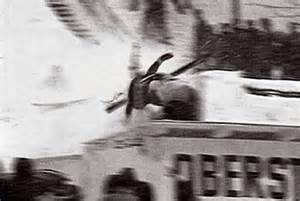
Do you ever wonder what happened to Vinko Bogataj? If that name doesn’t ring a bell for you, think back to the opening scenes from the ABC Television Show—“The Wide World of Sports.” With melodramatic music playing in the background, Jim McKay proclaimed, “Spanning the globe to bring you the constant variety of sports—the thrill of victory and the agony of defeat ….” If you remember that opening, you will remember Vinko Bogataj. He was the ski flier who lost his balance and tumbled head over heels, crashing into a retaining fence—an indelible image of the “agony of defeat.”

Aghony of defeat

Have you had a Vinko Bogataj experience? Has there been a time in your life when you failed so badly that a condemning image of that failure is permanently seared into your psyche? Does that image, like the video clip of Bogataj’s fall, get replayed over and over in your head, compounding your own agony of defeat? Wouldn’t it be wonderful to erase that clip from your memory and finally know the thrill of victory? Wouldn’t it be freeing to find a way to forgive yourself?

It seems every other sermon or devotional lately has focused on forgiveness. Pope Francis has declared two-thousand sixteen the Jubilee Year of Mercy. Saddleback Church’s focus is on the Miracle of Mercy; while other churches have related themes. Why mercy? Many people view God as a god of judgement and vengeance, but the Scriptures paint a very different picture. Mercy is the attribute of God that is most repeated in Scripture.

But before we can appreciate God as a god of mercy, we first must get past the old image of God as a god of judgement. This can be especially problematic if someone was raised in a household where, in particular, the father figure was critical, condemning, or abusive. Embracing a God of love and mercy is difficult when we try to judge our heavenly Father using an imperfect earthly father as our model.

In Isaiah 55:8-10 we are reminded that God is much more than we can imagine—we underestimate his love, even if we attempt to compare him to the most loving human father.

My thoughts are nothing like your thoughts,” says the Lord. “And my ways are far beyond anything you could imagine. For just as the heavens are higher than the earth, so my ways are higher than your ways and my thoughts higher than your thoughts.”

Unlike our human fathers, God is not interested in re-runs. Psalm 103:8-12, as translated in the International Children’s Version, tells us just how different our Heavenly Father is:

The Lord is compassionate and gracious, Slow to anger and abounding in lovingkindness. He will not always strive with us, Nor will He keep His anger forever. He has not dealt with us according to our sins, Nor rewarded us according to our iniquities. For as high as the heavens are above the earth, So great is His lovingkindness toward those who fear Him. As far as the east is from the west, So far has He removed our transgressions from us.

“As far as the east is from the west,” the psalmist says. Think about that—how far east do you have to go before you are headed west? The psalmist is telling us that when God forgives, he does not turn back from his Word. In 1 John 1:9 we read, “But if we confess our sins, he will forgive our sins. We can trust God. He does what is right. He will make us clean from all the wrongs we have done.”

If God isn’t interested in rehashing past sins, why should we? Once you have asked God to forgive you, it’s a closed issue for him. The next time that video clip of past failures starts playing in your brain, ask God to forgive you for doubting his forgiveness. Then ask him to show you how to leave the agony of past defeats behind, and claim victory in Jesus by forgiving yourself … and by forgiving your earthly father for not being perfect either.

Victory in Jesus

O victory in Jesus, My Savior, forever.
He sought me and bought me
With His redeeming blood;
He loved me ere I knew Him,
And all my love is due Him,
He plunged me to victory,
Beneath the cleansing flood.

— Eugene Monroe Bartlett, Sr.

Blessings, Your friends in Christ
In case you are still wondering—Vinko Bogataj suffered a concussion but returned to skiing the next year. Now retired from skiing, Vinko lives in his home town of Lesce, Slovenia where he is a landscape painter.

He Dropped the Ball

Dear Friends,

Have you ever heard anyone use the expression, “he dropped the ball?” That expression has an interesting history.

In the 1941 World Series of Baseball, the powerful New York Yankees played against their cross-town rivals the Brooklyn Dodgers. That’s right LA fans – the Dodgers used to play in Brooklyn, NY. The Dodgers were trailing two games to one, but in game four, things seemed to be turning in the favor of the Dodgers. It was the bottom of the ninth. The Dodgers had a four runs to three advantage with two out, two strikes on the batter, and no runners on base for the Yankees. One strike away from victory!

The Dodger’s pitcher threw a sharply breaking curve ball that should have been the final strike on Yankee’s batter Tommy Heinrich, but the Dodger’s victory slipped away as the ball caromed off of catcher Mickey Owen’s glove and skidded to the backstop. Heinrich was able to steal first base on the Owens error. The Yankees rallied and won the game 7-4. The next day, the Yankees went on to win the World Series.

He dropped the ball

Mickey Owen, who died Wednesday at age 89, was the jug-eared, brawling Dodgers catcher who became a Brooklyn byword for “goat” with his infamous dropped third strike in the 1941 World Series, versus the Yankees.

Now, do you want to know something interesting about the catcher Mickey Owen? Mickey Owen’s .995 fielding percentage in 1941 was a record for fielding efficiency – a record that still stands today!

Mickey Owens approached perfection in fielding; and yet, one mistake soiled his entire legacy. When he died, his obituary read, “Mickey Owen – The Man who dropped the ball.”

Do you sometimes feel like that one mistake, that one bad decision, or that one wrong choice will end up defining your legacy? Do you wonder if you will be remembered for the good you did, or as just another man or woman who “dropped the ball?”

One of the benefits of studying the Bible is that you discover that “dropping the ball” doesn’t define your legacy in God’s eyes. As we read in Romans, “For all have sinned and fall short of the glory of God, and all are justified freely by his grace through the redemption that came by Christ Jesus.” Romans 3:23-24 (NIV)

Abraham lied (Genesis 20) , Jacob deceived his father and stole his brother Esau’s inheritance (Genesis 25), David committed adultery with Bathsheba and had her husband Uriah murdered (2 Samuel). Peter Denied Christ (Matthew 26), and Paul persecuted the church (Acts 9). But as we read the stories of each of these heroes of the faith, we learn God is a god of second chances. Isn’t it reassuring to know that God doesn’t define us based on our mistakes; he loves and accepts us even when we drop the ball.

Verse of the week: “Now to him who is able to do immeasurably more than all we ask or imagine, according to his power that is at work within us, to him be glory in the church and in Christ Jesus throughout all generations, for ever and ever!    Amen.”  (Ephesians 3:20-21)

Blessings,
Your friends in Christ


Ten Things That Will Never Change

Dear Friends,

If it is possible, as far as it depends on you, live at peace with everyone.” Romans 12:18 (NIV)

A few years ago we heard the following words of wisdom, “In any relationship there are ten things about the other person that will irritate you – and those things will never change.” Think about that. Whether you’re talking about your mate, a sibling, your child, a friend, or a business associate — given enough time — you will find there are ten things about that other person that irritate you, and no matter how much you try to make that person change, they can’t or won’t!

Now we aren’t talking about addictions or major character defects like dishonesty or abusiveness. Those require interventions and prayer. “Surely the arm of the Lord is not too short to save, nor his ear too dull to hear.” Isaiah 59:1 Rather, we are talking about those little quirks or habits that can really get under your skin. Bonnie likes to tease that I have at least two dozen of those immutable irritants … and the number keeps growing. Take, for instance, my use of puns. If she had her way, I be put in a punitentiary … see what I mean?

Since we all will have to deal with those “ten things”, the question becomes, “How can we prevent the ten things from damaging an otherwise wonderful relationship? A good starting point is found in Reinhold Niebur’s Serenity Prayer.

serenity prayer

Accepting the things we cannot change begins with accepting the fact that they indeed cannot or will not change. Then, follow the wisdom found in Proverbs 21:9 (MSG), “Better to live alone in a tumbledown shack than share a mansion with a nagging spouse” (or sibling, or friend, … ). No one ever nagged — or ever loved — someone else to perfection.

Having the courage to change the things we can begins with changing the one thing we can control – our attitude.  Jesus commanded us, “Love each other.” He didn’t say, “Love each other except when …” In I Corinthians 13 we learn what loving each other involves, “Love is patient and kind. Love is not jealous or boastful or proud or rude. It does not demand its own way. It is not irritable, and it keeps no record of being wronged. It does not rejoice about injustice but rejoices whenever the truth wins out. Love never gives up, never loses faith, is always hopeful, and endures through every circumstance.”

Having the wisdom to know the difference begins with prayer. “We continually ask God to fill you with the knowledge of his will through all the wisdom and understanding that the Spirit gives, so that you may live a life worthy of the Lord and please him in every way: bearing fruit in every good work, growing in the knowledge of God, being strengthened with all power according to his glorious might so that you may have great endurance and patience,” Colossians 1:9b-11 (NIV)

In the tapestry of a relationship, the ten things that will never change normally start out as minor threads, but can grow to dominate the pattern. Lean on the One who never changes to be a constant thread that keeps your relationship beautiful.

Verse for the week: Romans 15:7 “Accept one another, then, just as Christ accepted you, in order to bring praise to God.”

Blessings,
Your Friends in Christ


Walking our Own Emmaus Road

Dear Friends,

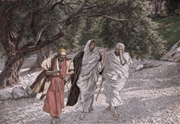
One way to bring the Bible to life is to put yourself in the shoes of the characters in key stories. This week we try to imagine what it was like to be one of the two disciples who met Jesus on the Road to Emmaus following His resurrection. This encounter is found in Luke 24:13-35.

The Road to Emmaus by Tissot

My name is Cleopas. I and another disciple were walking to Emmaus, a small village about seven miles from Jerusalem when we were approached by a stranger. At first, I thought he was from another region because he didn’t seem to know anything about the things that had happened in Jerusalem. I even asked him, “Are you the only one visiting Jerusalem who does not know the things that have happened there in these days?

My companion and I started to tell him about Jesus of Nazareth. We told him that Jesus was a prophet, powerful in word and deed before God and all the peoplewe had hoped he was the one who was to redeem Israel (The Messiah). But, the chief priests and our rulers had turned Jesus over to the Romans, who had crucified him.

This was the third day and Jesus had said he would be raised from the dead. Mary Magdalene, Mary the mother of James, and Salome had gone to the tomb early in the morning and found the large stone at the entrance had been rolled away, but they didn’t find Jesus body. They told us that they had seen a vision of angels who told them Jesus was alive. The disciples Peter and John had run to the tomb and found it was as the women said, but they did not see Jesus.

When we finished speaking, the stranger spoke, “How foolish you are, and how slow to believe all that the prophets have spoken! Did not the Messiah have to suffer these things and then enter his glory?” And beginning with Moses and all the Prophets, he explained to them what was said in all the Scriptures concerning (Jesus).”

As we approached the village to which we were going, the stranger continued on as if he were going farther. But we urged him strongly, “Stay with us, for it is nearly evening; the day is almost over.” So he went in to stay with us. When he was at the table with us, he took bread, gave thanks, broke it and began to give it to us. Then my eyes were opened and I recognized Jesus. Then he disappeared from our sight. I asked my companion, “Were not our hearts burning within us while he talked with us on the road and opened the Scriptures to us?”

Why didn’t we recognize Jesus? I guess you could say we lacked “expectant hope”. We didn’t see Jesus because we didn’t truly expect to see him. Can you blame us? Our Master had promised he would be raised from the dead, but after his torture and murder at the hands of the Romans, who could expect to see him walking and talking as if nothing had happened? I didn’t recognize Jesus because I had put my hope in Jesus the man, not Jesus the Son of God.

I should have remembered Proverbs 11:7: “Hopes placed in mortals die with them; all the promise of their power comes to nothing.”

Who do we put our hope in? Isaiah tells us, … Those who hope in the Lord will renew their strength. They will soar on wings like eagles; they will run and not grow weary, they will walk and not be faint. Isaiah 40:31.

The Psalmist tells us, “Guide me in your truth and teach me, for you are God my Savior, and my hope is in you all day long.” Psalm 25:5. Notice the phrase, “My hope is in you all day long.” Are we hoping expectantly for God to respond to our prayers? Do we even pray, or is our first response to turn inward or outward rather than upward?

Recently I went through a difficult period when an important project didn’t go as planned. Being a man, I immediately went into problem-solving mode, searching Google for answers, contacting friends for ideas, and doing everything in my power to make things right. Finally, accepting the old adage — when all else fails — pray; I turned to prayer.

The problem still exists. Some might argue that God ignored my prayers, but I would say he responded by helping me to change my attitude about the problem. As I walked my own Emmaus Road, I initially failed to see who was walking with me. Like the disciples on the Road to Emmaus, we need to learn to live with expectant hope.

Verse for the Week: Micah 7:7

“But as for me, I watch in hope for the Lord, I wait for God my Savior; my God will hear me.”

Blessings,

Your friends in Christ