Walking our Own Emmaus Road

Dear Friends,

One way to bring the Bible to life is to put yourself in the shoes of the characters in key stories. This week we try to imagine what it was like to be one of the two disciples who met Jesus on the Road to Emmaus following His resurrection. This encounter is found in Luke 24:13-35.
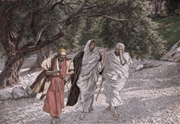
The Road to Emmaus by Tissot

My name is Cleopas. I and another disciple were walking to Emmaus, a small village about seven miles from Jerusalem when we were approached by a stranger. At first, I thought he was from another region because he didn’t seem to know anything about the things that had happened in Jerusalem. I even asked him, “Are you the only one visiting Jerusalem who does not know the things that have happened there in these days?”

My companion and I started to tell him about Jesus of Nazareth. We told him that Jesus was a prophet, powerful in word and deed before God and all the people — we had hoped he was the one who was to redeem Israel (The Messiah). But, the chief priests and our rulers had turned Jesus over to the Romans, who had crucified him.

This was the third day and Jesus had said he would be raised from the dead. Mary Magdalene, Mary the mother of James, and Salome had gone to the tomb early in the morning and found the large stone at the entrance had been rolled away, but they didn’t find Jesus body. They told us that they had seen a vision of angels who told them Jesus was alive. The disciples Peter and John had run to the tomb and found it was as the women said, but they did not see Jesus.

When we finished speaking, the stranger spoke, “How foolish you are, and how slow to believe all that the prophets have spoken! Did not the Messiah have to suffer these things and then enter his glory?” And beginning with Moses and all the Prophets, he explained to them what was said in all the Scriptures concerning (Jesus).”

As we approached the village to which we were going, the stranger continued on as if he were going farther. But we urged him strongly, “Stay with us, for it is nearly evening; the day is almost over.” So he went in to stay with us. When he was at the table with us, he took bread, gave thanks, broke it and began to give it to us. Then my eyes were opened and I recognized Jesus. Then he disappeared from our sight. I asked my companion, “Were not our hearts burning within us while he talked with us on the road and opened the Scriptures to us?”

Why didn’t we recognize Jesus? I guess you could say we lacked “expectant hope”. We didn’t see Jesus because we didn’t truly expect to see him. Can you blame us? Our Master had promised he would be raised from the dead, but after his torture and murder at the hands of the Romans, who could expect to see him walking and talking as if nothing had happened? I didn’t recognize Jesus because I had put my hope in Jesus the man, not Jesus the Son of God.

I should have remembered Proverbs 11:7: “Hopes placed in mortals die with them; all the promise of their power comes to nothing.”

Who do we put our hope in? Isaiah tells us, “… Those who hope in the Lord will renew their strength. They will soar on wings like eagles; they will run and not grow weary, they will walk and not be faint. Isaiah 40:31.

The Psalmist tells us, “Guide me in your truth and teach me, for you are God my Savior, and my hope is in you all day long.” Psalm 25:5. Notice the phrase, “My hope is in you all day long.” Are we hoping expectantly for God to respond to our prayers? Do we even pray, or is our first response to turn inward or outward rather than upward?

Recently I went through a difficult period when an important project didn’t go as planned. Being a man, I immediately went into problem-solving mode, searching Google for answers, contacting friends for ideas, and doing everything in my power to make things right. Finally, accepting the old adage — when all else fails — pray; I turned to prayer.

The problem still exists. Some might argue that God ignored my prayers, but I would say he responded by helping me to change my attitude about the problem. As I walked my own Emmaus Road, I initially failed to see who was walking with me. Like the disciples on the Road to Emmaus, we need to learn to live with expectant hope.

Verse for the Week: Micah 7:7

“But as for me, I watch in hope for the Lord, I wait for God my Savior; my God will hear me.”

Blessings,

Your friends in Christ


Risen Indeed!

Dear Friends,

What would you say is the single most important word at Easter?  Some might say, “Jesus,” and of course there would be no Easter without Jesus. Others might say, “resurrection or risen.” The entire Easter story is about the resurrection; however, we would like to suggest that the most important word for each of us may be the word “INDEED”.

Serve a Risen Savior

Many churches begin their Easter Service with the celebrant proclaiming, “Christ is RISEN,” and the congregation responding, “Christ is risen INDEED!” Indeed: truly, undeniably, without a doubt … Really? Can you indeed join with the hymnist who wrote:

I serve a risen Savior, he’s in the world today;
I know that he is living whatever men may say;
I see his hand of mercy; I hear his voice of cheer,
And just the time I need him, he’s always near.

Chorus:
He lives, he lives, Christ Jesus lives today!
He walks with me and talks with me
Along life’s narrow way.
He lives, he lives, salvation to impart!
You ask me how I know he lives
He lives within my heart.

Romans 10:9 (NIV) forms the basis for our suggestion that “indeed” may be the most important word associated with the Easter story. “If you declare with your mouth, “Jesus is Lord,” and believe in your heart that God raised him from the dead, you will be saved.” This is not an intellectual exercise. You can listen to countless sermons on the resurrection, read every book ever written on the subject, memorize the Easter story, and like the disciple Thomas still say, “Unless I see the nail marks in his hands and put my finger where the nails were, and put my hand into his side, I will not believe.” John 20:25

The proof of the resurrection is found in the impact that a living Jesus has in your life. We echo the words of the Apostle Paul, “I pray that from his glorious, unlimited resources he will empower you with inner strength through his Spirit. Then Christ will make his home in your hearts as you trust in him. Your roots will grow down into God’s love and keep you strong. And may you have the power to understand, as all God’s people should, how wide, how long, how high, and how deep his love is. May you experience the love of Christ, though it is too great to understand fully. Then you will be made complete with all the fullness of life and power that comes from God.” Ephesians 3:15-20 (NLT)

Christ is RISEN! Christ is risen INDEED!

Verse for the week: 2 Corinthians 6:1-2
“As God’s partners, we beg you not to accept this marvelous gift of God’s kindness and then ignore it. For God says, “At just the right time, I heard you. On the day of salvation, I helped you. Indeed, the “right time” is now. Today is the day of salvation.”

Blessings,
Your Friends in Christ


Are You Using Your Prayer Button?

Dear Friends,

Anyone who watches Television has seen the advertisement for an emergency call button from First Alert®. Recently my sister Shirley moved into an assisted living facility where residents are supplied a similar device, but the device they are given is much more than an emergency response device. Residents can use the button to summon an attendant whenever they need assistance whether for an emergency – such as a fall – or for something as simple as wanting an escort to show them where a particular activity is taking place.

I've fallen

God has given each of us our own call button: PRAYER. “I am praying to you because I know you will answer, O God.  Bend down and listen as I pray.” Psalm 17:6 (NLT)

The question is, “When do we pray?”

In 1 Thessalonians 5:16-18 (NIV) we read, “Rejoice always, pray continually, give thanks in all circumstances; for this is God’s will for you in Christ Jesus.” When I read this Scripture, I have to pause at the word “continually”. Do I pray very often; at regular or frequent intervals; habitually, without cessation or intermission; unceasingly; always? Do I give thanks in all circumstances or just when life is going my way?

A few weeks ago I was driving to LAX to catch a flight back East. Suddenly, I saw in my rear view mirror the flashing blue lights of a highway patrol cruiser. It turned out that I had swerved out of my lane at one point and the officer suspected I might be a drunk driver. After a few questions, he told me to drive carefully and drove away. As he departed, I noticed the words “To Serve and Protect” on the side of the patrol car. I offered a quick prayer of thanksgiving for the officer. I wonder if I would have offered a prayer of thanksgiving had the officer given me a ticket.

Many of us are not what you would call prayer warriors. We may know and recite prayers in church; grace at meals may even be a habit. But our most earnest prayers are often reserved for those times when we find ourselves in a trouble or when we acknowledge our sinfulness and plead for mercy. “The Lord has heard my cry for mercy; the Lord accepts my prayer.” Psalm 6:9.

But God didn’t give us prayer as something to do only when all else fails. Our prayer button is available 24-7. From a simple “Thank You” for the day the Lord has given us to a gentle “Now I lay me down to sleep;” our days can be sprinkled with prayers. In Ephesians 6:8 the Apostle Paul advises us, “And pray in the Spirit on all occasions with all kinds of prayers and requests.”

James the brother of Jesus offered his thoughts on prayer in James 5:13-16 (NLT):  “Are any of you suffering hardships? You should pray. Are any of you happy? You should sing praises. Are any of you sick? You should call for the elders of the church to come and pray over you, anointing you with oil in the name of the Lord. Such a prayer offered in faith will heal the sick, and the Lord will make you well. And if you have committed any sins, you will be forgiven.  Confess your sins to each other and pray for each other so that you may be healed. The earnest prayer of a righteous person has great power and produces wonderful results.”

Ready – Set – Pray!

Verse for the week: Psalm 65:5 (ICB) “You answer us in amazing ways, God our Savior. People everywhere on the earth and beyond the sea trust you.”

Blessings,
Your friends in Christ



Where Honor is Due

Dear Friends,

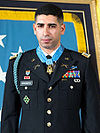
Recently we had the honor of meeting Congressional Medal of Honor awardee Captain Florent A. Groberg, U.S. Army (Ret.), who sustained serious injuries when he risked his life to protect the members of his patrol. Caught in an ambush on a bridge, Captain Groberg noticed a civilian running toward his platoon. As Groberg raced toward the man, he noticed an explosive vest under the man’s clothing. Groberg and his comrade Sergeant Andrew Mahoney pushed the attacker repeatedly until the man fell on his chest. The vest exploded throwing Captain Groberg 15-20 feet. Although four members of the platoon lost their lives, the death toll would have been much higher had it not been for the courageous actions of Groberg.

Florent_Groberg_awarded-Medal-of-Honor-(cropped)

Capt. Groberg spent nearly three years recovering at Walter Reed National Military Medical Center and endured 33 surgeries. When he was informed that he would receive the Medal of Honor, he said, “This medal belongs to them. It’s my mission to tell everyone thank you for recognizing me, but this does not belong to me. It belongs to them. That’s how I’m coping with it mentally.”

As Bonnie and I spoke with Captain Groberg, we were impressed by his humility. When Bonnie told his Fiance, “I believe that Captain Groberg did what he did for me and for every American,” his fiancé quietly responded, “That’s the way he feels too.”

Jesus said, “Greater love has no one than this: to lay down one’s life for one’s friends.” John 15:13 (NIV) Captain Groberg demonstrated his love for his platoon members when he was willing to sacrifice himself to save them. God demonstrated his love for us when he sent Jesus – “For God so loved the world that he gave his one and only Son, that whoever believes in him shall not perish but have eternal life.” John 3:16

Captain Groberg was an ordinary man who did an extraordinary thing. Every day we ordinary Christians have the opportunity to do something extraordinary: we can bring glory to God by sharing with others the Good News that Christ died for them, too.

The rest of the story … We met the Captain as we were boarding a Southwest Airlines flight from Cleveland to Washington, D.C. After we boarded the plane, Bonnie mentioned to the stewardess that Captain Groberg was on the flight. Instantly she raced to the front of the aircraft, grabbed the microphone, and announced, “We have a true American hero on board, let’s show our thanks to Medal of Honor recipient Florent Groberg.” The entire plane erupted with applause. We were proud to be part of such an outpouring of thanks.

Scripture for the Week: Romans 13:7 (NIV) “Give honor to whom honor is due.”

Blessings, Your Friends in Christ

Avoiding the Rocks

Dear Friends,

One of the most interesting jobs I ever had was with a company that developed the offshore survival suit. If you have watched the TV show, “The Deadliest Catch,” you may have seen the fishermen putting on large red full-body suit that allows them to survive for several hours in frigid arctic waters.

One weekend, Nick Samela, the company president and I became actors, as we shot a video of the suits in use. We donned survival suits and jumped from a Coast Guard rescue boat into the choppy waters off of Astoria, Washington. The tide changes near the mouth of the Columbia River make for some of the most dangerous water in the world so we knew it would be the perfect place to make our video.

Everything was going according to plan until suddenly the tide started to change. Floating on my back in a huge rubber suit, I was unaware of any danger until I heard the low clanging of a bell – ding swish, ding swish.

Nick was within a few yards of me, so I shouted to him to ask him what the bell was. He paddled hard to change his position, then he shouted back to me.

“Don, we are in trouble. That’s a channel buoy – we are being swept onto the rocks.”

I started paddling like crazy and managed to get back into the current. Good news – bad news, I was now being swept out to sea. The Coast Guard rescue boat made a couple of attempts to pick us up, but as the waves became rougher, the decision was made to call for a helicopter rescue. You can’t begin to imagine how relieved I was when we were finally lifted into the hatch of the helicopter in a rescue sling. My guardian angel had rotor blades, not wings!

helicopter rescue

I share this story because it provides an interesting metaphor for how people approach sin. The Bible tells us that the wages of sin is death. But, just like the waters off Astoria, sin may initially seem like something we can handle. The problem is that the sea of sin is unpredictable. The changing tide pulled me toward the rocks; similarly, sin has its own magnetic pull. A small taste of sin whets the appetite for more. We indulge until our lives are slowly pulled out of control.

Sin pulls us away from relationship with friends, away from relationship with family, and most important, away from our relationship with God.

“But I’m a Christian,” you may say. “I am washed by Jesus blood. All that I have to do is confess my sins and all is forgiven.”

The Apostle Paul addressed this response in Romans 6:1-2:

“What shall we say, then? Shall we go on sinning so that grace may increase? By no means! We are those who have died to sin; how can we live in it any longer?”
Repentance involves four distinct actions:

  1. Admitting or confessing sin.
  2. Ceasing the sin
  3. Resolving to not repeat the offense.
  4. Making restitution or amends where possible.

    If all we do is confess our sin, we may have encountered the warning buoy, but we are still headed for the rocks.

    There is a huge difference between a confession that comes from a broken spirit and a flippant “My bad! You caught me;”In 2 Corinthians 7:10 we read, “Godly sorrow brings repentance that leads to salvation and leaves no regret, but worldly sorrow brings death.” To confess and then go on sinning is to be caught in a current that may ultimately lead to disaster.

    The good news is that just like there was a helicopter standing by to pull me from the threatening waters, there is a savior who wants to pull us to repentance. We can take comfort in Jesus’ words found in Luke 15:7: “there will be more rejoicing in heaven over one sinner who repents than over ninety-nine righteous persons who do not need to repent.”And we all need to repent. The Bible tells that all have sinned and fall short of the glory of God. We all need to repair broken relationships with the Father.

    One thing is certain; being human we will face temptation. On our own we won’t have the power to keep from sinning. We need another source of power. Praise God; that power will come from the Spirit of Christ working within us.|

    Verse for the Week: Romans 3:23-24
    “for all have sinned and fall short of the glory of God, and all are justified freely by his grace through the redemption that came by Christ Jesus.”

    Blessings,
    Your Friends in Christ