Dear Friends:
Do you ever wonder what happened to Vinko Bogataj? If that name doesn’t ring a bell for you, think back to the opening scenes from the ABC Television Show—“The Wide World of Sports.” With melodramatic music playing in the background, Jim McKay proclaimed, “Spanning the globe to bring you the constant variety of sports—the thrill of victory and the agony of defeat ….” If you remember that opening, you will remember Vinko Bogataj. He was the ski flier who lost his balance and tumbled head over heels, crashing into a retaining fence—an indelible image of the “agony of defeat.”
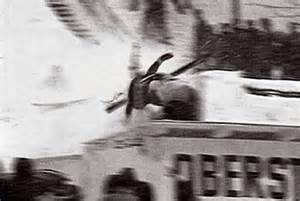
Have you had a Vinko Bogataj experience? Has there been a time in your life when you failed so badly that a condemning image of that failure is permanently seared into your psyche? Does that image, like the video clip of Bogataj’s fall, get replayed over and over in your head, compounding your own agony of defeat? Wouldn’t it be wonderful to erase that clip from your memory and finally know the thrill of victory? Wouldn’t it be freeing to find a way to forgive yourself?
It seems every other sermon or devotional lately has focused on forgiveness. Pope Francis has declared two-thousand sixteen the Jubilee Year of Mercy. Saddleback Church’s focus is on the Miracle of Mercy; while other churches have related themes. Why mercy? Many people view God as a god of judgement and vengeance, but the Scriptures paint a very different picture. Mercy is the attribute of God that is most repeated in Scripture.
But before we can appreciate God as a god of mercy, we first must get past the old image of God as a god of judgement. This can be especially problematic if someone was raised in a household where, in particular, the father figure was critical, condemning, or abusive. Embracing a God of love and mercy is difficult when we try to judge our heavenly Father using an imperfect earthly father as our model.
In Isaiah 55:8-10 we are reminded that God is much more than we can imagine—we underestimate his love, even if we attempt to compare him to the most loving human father.
My thoughts are nothing like your thoughts,” says the Lord. “And my ways are far beyond anything you could imagine. For just as the heavens are higher than the earth, so my ways are higher than your ways and my thoughts higher than your thoughts.”
Unlike our human fathers, God is not interested in re-runs. Psalm 103:8-12, as translated in the International Children’s Version, tells us just how different our Heavenly Father is:
The Lord is compassionate and gracious, Slow to anger and abounding in lovingkindness. He will not always strive with us, Nor will He keep His anger forever. He has not dealt with us according to our sins, Nor rewarded us according to our iniquities. For as high as the heavens are above the earth, So great is His lovingkindness toward those who fear Him. As far as the east is from the west, So far has He removed our transgressions from us.
“As far as the east is from the west,” the psalmist says. Think about that—how far east do you have to go before you are headed west? The psalmist is telling us that when God forgives, he does not turn back from his Word. In 1 John 1:9 we read, “But if we confess our sins, he will forgive our sins. We can trust God. He does what is right. He will make us clean from all the wrongs we have done.”
If God isn’t interested in rehashing past sins, why should we? Once you have asked God to forgive you, it’s a closed issue for him. The next time that video clip of past failures starts playing in your brain, ask God to forgive you for doubting his forgiveness. Then ask him to show you how to leave the agony of past defeats behind, and claim victory in Jesus by forgiving yourself … and by forgiving your earthly father for not being perfect either.

O victory in Jesus, My Savior, forever.
He sought me and bought me
With His redeeming blood;
He loved me ere I knew Him,
And all my love is due Him,
He plunged me to victory,
Beneath the cleansing flood.
— Eugene Monroe Bartlett, Sr.
Blessings, Your friends in Christ
In case you are still wondering—Vinko Bogataj suffered a concussion but returned to skiing the next year. Now retired from skiing, Vinko lives in his home town of Lesce, Slovenia where he is a landscape painter.
 Because He Loves Us Press