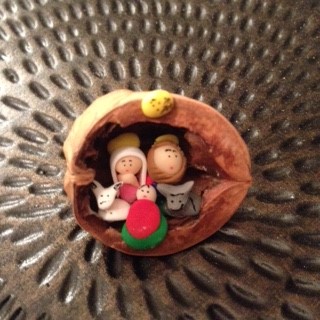
If someone asked you to give them the true meaning of Christmas in a nutshell, what would you say? Usually, people think about Mary and Joseph, the baby in a manger, the shepherds, and the wise men, the story of the nativity, as found in the gospels of Mathew and Luke. To get to a deeper understanding of the meaning of Christmas, turn to John 1:5.
In the beginning was the Word, and the Word was with God, and the Word was God. He was with God in the beginning. Through him all things were made; without him nothing was made that has been made. In him was life, and that life was the light of all mankind. The light shines in the darkness, and the darkness has not overcome it. John 1:1-5 (NIV)
In John 1, we learn much more about that baby born in Bethlehem. Jesus is the Word: the second member of the trinity who existed with God before anything came into being. He was the architect of creation who, with God, hung the stars in the sky and created a world where life was miraculously possible.
Existing outside of time and space, God is separate from His creation, yet when we read “In Him was life,” we are reminded that God is a person, not some impersonal force or prime mover. When Jesus prayed, “Abba, Father,” in the Garden of Gethsemane, he used a word that can be translated, “daddy.” In a world filled with so much darkness, it is comforting to know that “Our daddy,” who art in Heaven, loved us so much that he sent his Son as a light to shine into the darkness of the world.
Life may seem dark for you right now. The good news is that help is on the way. Christmas reminds us that we have a life-giving, all-powerful, and personal God who sent the Word as a light in our darkness.When Jesus spoke again to the people, he said, “I am the light of the world. Whoever follows me will never walk in darkness, but will have the light of life.” John 8:12 (NIV)
Last Sunday many churches began the celebration of Advent by lighting the first of five candles in the Advent wreath. In researching Advent, I discovered that the wreath is traditionally made of evergreens, symbolizing eternal life. The circle reminds us of the eternity of God and of his unending love, and the red berries in the wreath remind us it was Jesus’ sacrifice on the cross that provided the way to eternal life.
The four colored candles in the wreath serve to remind us of four virtues: Hope, Love, Joy, and Peace that emanate from a right relationship with God. The fifth candle, a white one, is symbolic of the sinless nature of Christ and is lit on Christmas Eve to remind us of Jesus’ words, “I am the light of the world. Whoever follows me will never walk in darkness but will have the light of life.” John 8:12 (NIV)
During Advent it is traditional to read sections of the book of Isaiah in which the coming of Christ was foretold. The opening two chapters of Matthew and Luke describe the circumstances surrounding the birth of Jesus.
When I read Luke’s gospel, I am intrigued by the special relationship between Mary and Elizabeth. Both women were to give birth to miraculous sons. Elizabeth would be the mother of John the Baptist, and Mary would deliver Jesus to the world.
Elizabeth was the wife of a priest named Zechariah. Zechariah and Elizabeth were righteous in God’s eyes, careful to obey all of the Lord’s commandments and regulations. They had no children because Elizabeth was unable to conceive, and they were both very old. Luke 1:6-7 (NLT)
For a woman in the culture of that day to be childless was considered a curse. Imagine the hope Elizabeth felt when her husband came home speechless after being told by the angel Gabriel that Elizabeth was to have a son … a son who would be a man with the spirit and power of Elijah. He will prepare the people for the coming of the Lord. He will turn the hearts of the fathers to their children, and he will cause those who are rebellious to accept the wisdom of the godly.” Luke 1:17
Mary was a teenager, engaged, but not yet married to Joseph. She was a virgin, so she must have been stunned when the angel told her, “Don’t be afraid, Mary, for you have found favor with God! You will conceive and give birth to a son, and you will name him Jesus. He will be very great and will be called the Son of the Most High. The Lord God will give him the throne of his ancestor David. And he will reign over Israel forever; his Kingdom will never end!” Luke 1:30-33
Luke tells us that a few days after Mary received the news from the angel Gabriel, she went to visit her relative Elizabeth (who was now six months pregnant). Mary entered the room and greeted Elizabeth.
At the sound of Mary’s greeting, Elizabeth’s child leaped within her, and Elizabeth was filled with the Holy Spirit. Luke 1:41
Did you catch that? Elizabeth’s child leaped within her. Talk about joy! Had they sonograms back then, would the baby in Elizabeth’s womb have been smiling? Did the women giggle, as many expectant mothers sometimes do when their baby moves inside them? Did the women talk with one another about their separate encounters with the angel Gabriel? What did it feel like for Elizabeth when she was filled with the Holy Spirit?
I want to know things the Gospel writer was not inspired to share. I want to see Elizabeth and Mary and their unborn sons as real people with real life problems, whose faith in God fit perfectly within His plan of salvation. What can their lives teach us that will help us claim more hope, love, and peace this Christmas season? What can make us leap for joy in the presence of the Lord?
Elizabeth gave a glad cry and exclaimed to Mary, “God has blessed you above all women, and your child is blessed. Why am I so honored, that the mother of my Lord should visit me? When I heard your greeting, the baby in my womb jumped for joy. You are blessed because you believed that the Lord would do what he said.” Luke 1: 42-45
Like Elizabeth and Mary, we need to be open to God’s calling and blessed because we believe God will do what he says he will do.
HOPE:I pray that God, the source of hope, will fill you completely with joy and peace because you trust in him. Then you will overflow with confident hope through the power of the Holy Spirit. Romans 15:13
This was an unusual weekend. I decided to drive by Tanyard Creek to see if anyone from Village Bible Church was handing out Bible tracts. I had joined two other church members in this evangelical effort last weekend—something way out of my comfort zone—but something I found to be unusually rewarding. If the team needed reinforcements, I was willing to help.
Arriving at Tanyard Creek, I was disappointed that no one was there. It was earlier than they normally start, so I headed home to knock out a few items on my to-do list. Time got away from me, and it was mid-afternoon before I gave the evangelical effort further thought.
The next morning, I was eager to go to church. I attend the 9 AM service. We also have a 10:30 service. As I turned the corner to enter the parking lot, there wasn’t a single car. I drove around the church, not a single person. Maybe there had been a power failure and I had missed the announcement, but there wasn’t even a note on the door. Momentarily, there was that sickening thought: The rapture happened, and I missed it. That’s the second time in the last few months that that thought came to me. Is God trying to tell me something?
Anyway, it finally dawned on me that I had been one day off starting with Friday; It was not Sunday, but Saturday. OK! I admit it, I’m getting old, but this turned out to be a fortuitous chronological hiccup. Tanyard Creek was on the way home. Entering the parking lot, I saw Mark Underwood. It turned out he was alone, so he welcomed my help.
Being a scientist and well-versed in the Bible, Mark is well-equipped to present the Gospel. He also has a wonderful approach to evangelism that can be used by anyone who loves the Lord. He starts with a friendly greeting in which he first gives his name and then says he is there to talk with people about their ideas about God. “Who is God to you?”
As I listened, his question elicited interesting responses: “My Father in Heaven,” “The Creator,” “Father, Son, and Holy Ghost combined,” and other straight-from-the-Bible responses. One woman offered a simple “I like Him.” A young man said, “He is my mentor.” One woman said she is a Christian and returned to let us listen to a lovely song she had found on TicToc: “Flowers” by Samantha Ebert.
Two Sisters from the Church of Jesus Christ of Latter-Day Saints stopped by and shared their ideas about Jesus with us, as did three men with Rugged Faith Ministries, a group that offers “Adventure with a Purpose.”
One of the most interesting visitors was a young man who called himself “a low-watt atheist” Mark took that comment to mean that “the young man felt he was stumbling in the dark without enough light to see clearly (thus “low-watt”) to believe in God.” Mark said he was especially glad when he returned from his hike—”He came up to us intentionally—to thank us again for the conversation and to say that he would be thinking more about what we talked about. It’s great when the people come up to us instead of the other way around.”
Mark added, “I will certainly pray for God to continue to work in that young man’s life to draw him back to faith in Him.”
The young man didn’t recommit his life to Christ, but he left with quite a bit to think about, as did I.
When was the last time you pondered the question, “Who is God to me?” We go to church. We pray. We tithe and try to love others as Jesus commanded, but how well do we know our God? As I stood listening to Mark, I found it difficult to put together in my mind a clear-cut answer to the question, Who is God to me?
For me, it is not a problem of too little faith, it is a problem of too much faith. It’s easy for me to believe the biblical descriptions of God because words like Father, shepherd, healer, guardian, comforter, master, teacher—even Lord are things I can see, feel, or touch, but God is so much more than all these combined. He’s hard to wrap our minds around.
Who is God to me? I am still working on that one. I’m sure it’s been said before, “A god small enough to define is simply too small to be God.”

 Because He Loves Us Press