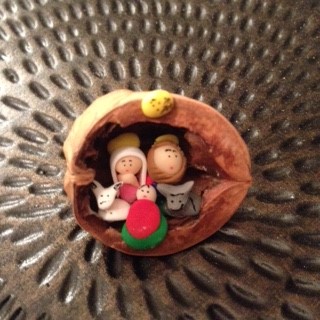
Christmas in a Nutshell

Dear Friends,

If someone asked you to give them the true meaning of Christmas in a nutshell, what would you say? Usually, people think about Mary and Joseph, the baby in a manger, the shepherds, and the wise men, the story of the nativity, as found in the gospels of Mathew and Luke. To get to a deeper understanding of the meaning of Christmas, turn to John 1:5.

In the beginning was the Word, and the Word was with God, and the Word was God. He was with God in the beginning. Through him all things were made; without him nothing was made that has been made. In him was life, and that life was the light of all mankind. The light shines in the darkness, and the darkness has not overcome it.  John 1:1-5 (NIV)

In John 1, we learn much more about that baby born in Bethlehem. Jesus is the Word: the second member of the trinity who existed with God before anything came into being. He was the architect of creation who, with God, hung the stars in the sky and created a world where life was miraculously possible.

Existing outside of time and space, God is separate from His creation, yet when we read “In Him was life,” we are reminded that God is a person, not some impersonal force or prime mover. When Jesus prayed, “Abba, Father,” in the Garden of Gethsemane, he used a word that can be translated, “daddy.”  In a world filled with so much darkness, it is comforting to know that “Our daddy,” who art in Heaven, loved us so much that he sent his Son as a light to shine into the darkness of the world. 

Life may seem dark for you right now. The good news is that help is on the way. Christmas reminds us that we have a life-giving, all-powerful, and personal God who sent the Word as a light in our darkness.When Jesus spoke again to the people, he said, “I am the light of the world. Whoever follows me will never walk in darkness, but will have the light of life.”  John 8:12 (NIV)

Blessings,
Your Friends in Christ

Advent: Leap for Joy

Last Sunday many churches began the celebration of Advent by lighting the first of five candles in the Advent wreath. In researching Advent, I discovered that the wreath is traditionally made of evergreens, symbolizing eternal life. The circle reminds us of the eternity of God and of his unending love, and the red berries in the wreath remind us it was Jesus’ sacrifice on the cross that provided the way to eternal life.

 The four colored candles in the wreath serve to remind us of four virtues: Hope, Love, Joy, and Peace that emanate from a right relationship with God. The fifth candle, a white one, is symbolic of the sinless nature of Christ and is lit on Christmas Eve to remind us of Jesus’ words, “I am the light of the world. Whoever follows me will never walk in darkness but will have the light of life.”
John 8:12 (NIV)

During Advent it is traditional to read sections of the book of Isaiah in which the coming of Christ was foretold. The opening two chapters of Matthew and Luke describe the circumstances surrounding the birth of Jesus.

When I read Luke’s gospel, I am intrigued by the special relationship between Mary and Elizabeth. Both women were to give birth to miraculous sons. Elizabeth would be the mother of John the Baptist, and Mary would deliver Jesus to the world.

Elizabeth was the wife of a priest named Zechariah. Zechariah and Elizabeth were righteous in God’s eyes, careful to obey all of the Lord’s commandments and regulations. They had no children because Elizabeth was unable to conceive, and they were both very old. Luke 1:6-7 (NLT)

For a woman in the culture of that day to be childless was considered a curse. Imagine the hope Elizabeth felt when her husband came home speechless after being told by the angel Gabriel that Elizabeth was to have a son a son who would be a man with the spirit and power of Elijah. He will prepare the people for the coming of the Lord. He will turn the hearts of the fathers to their children, and he will cause those who are rebellious to accept the wisdom of the godly.” Luke 1:17

Mary was a teenager, engaged, but not yet married to Joseph. She was a virgin, so she must have been stunned when the angel told her, “Don’t be afraid, Mary, for you have found favor with God! You will conceive and give birth to a son, and you will name him Jesus. He will be very great and will be called the Son of the Most High. The Lord God will give him the throne of his ancestor David. And he will reign over Israel forever; his Kingdom will never end!” Luke 1:30-33

Luke tells us that a few days after Mary received the news from the angel Gabriel, she went to visit her relative Elizabeth (who was now six months pregnant). Mary entered the room and greeted Elizabeth.

At the sound of Mary’s greeting, Elizabeth’s child leaped within her, and Elizabeth was filled with the Holy Spirit.  Luke 1:41

Did you catch that? Elizabeth’s child leaped within her. Talk about joy! Had they sonograms back then, would the baby in Elizabeth’s womb have been smiling? Did the women giggle, as many expectant mothers sometimes do when their baby moves inside them? Did the women talk with one another about their separate encounters with the angel Gabriel? What did it feel like for Elizabeth when she was filled with the Holy Spirit?

I want to know things the Gospel writer was not inspired to share. I want to see Elizabeth and Mary and their unborn sons as real people with real life problems, whose faith in God fit perfectly within His plan of salvation. What can their lives teach us that will help us claim more hope, love, and peace this Christmas season? What can make us leap for joy in the presence of the Lord?

Elizabeth gave a glad cry and exclaimed to Mary, “God has blessed you above all women, and your child is blessed. Why am I so honored, that the mother of my Lord should visit me? When I heard your greeting, the baby in my womb jumped for joy. You are blessed because you believed that the Lord would do what he said.” Luke 1: 42-45

Like Elizabeth and Mary, we need to be open to God’s calling and blessed because we believe God will do what he says he will do.

HOPE: I pray that God, the source of hope, will fill you completely with joy and peace because you trust in him. Then you will overflow with confident hope through the power of the Holy Spirit.  Romans 15:13

Blessings,
Your Friend in Christ

To Kneel or Not to Kneel

Growing up in the Church of the Epiphany in Washington, D.C., serving as an acolyte may be part of the reason for my bad knees. Even when the Book of Common Prayer indicated congregants could either stand or kneel, Rector Kane opted for kneeling. In fairness, I must admit that soccer, tennis, and football deserve most of the blame for my bad knees.

As a young adult, I found kneeling uncomfortable and spent part of the time on my knees, allegedly in prayer, praying that the prayers would soon end. Why would he put us through such torture? I wondered. As I look back on those days, I realize that I was trending toward the less spiritual side on the pendulum of spirituality,

Recently, I was reintroduced to Psalm 95, and the words—Come let us worship and fall down. Let us kneel before the Lord our maker—caught my attention.  I wondered how many times the words kneel or bow down (related to the worship of God) appear in the Bible.  I discovered a score or more verses about bowing down to God and scores of verses that refer to God’s prohibition on bowing down to worship anyone or anything else.

Bow down – a verb meaning to bend at the neck, waist, or knees as a display of respect, honor, or obedience. It is an expression of humility.

It is noteworthy that the only verses in the New Testament that use the words bow down are found in Matthew 2:11 where the Maji bowed down to the baby Jesus, and the words Satan spoke to Jesus,
recorded in Matthew 4:9: “All this I will give you,” he said, “if you will bow down and worship me.”

In Ephesians 3:14, the apostle Paul wrote about kneeling to the Father, but that was more of a comment on his personal practice, not a general prescription for prayer. Does that mean that bowing down (kneeling) became old school, something that was not required of followers of Jesus?   

I believe that New Testament writers used another word found approximately 70 times in the Bible: humble. Over the years, countless pastors have reminded their congregations, “If something appears three times in Scripture, God wants you to pay special attention to it.” What about verbs (action words) that appear repeatedly, like bow down and humble?

Come, let us bow down in worship, let us kneel before the Lord our Maker;
for he is our God and we are the people of his pasture, the flock under his
care.
Psalm 95:6-7 (NIV)

The Lord upholds all who fall and lifts up all who are bowed down. Psalm 145:14

Humble yourselves, therefore, under God’s mighty hand, that he may lift you up in due time.
1 Peter 5:6

So, what do we do about this? It is unlikely (and not something I would encourage) that our churches will suddenly start to include kneeling during prayer as part of their ritual. It would be uncomfortable for many and seem legalistic to others. There is, however, something every believer can choose to do on their own. In your quiet time, bow down in worship, kneel before the Lord our maker.

Recently I found myself in a dry period when it came to my prayers. I was saying the words, but my mind and heart were elsewhere. Then one morning, I don’t know if it was part of a devotional, remembrance of a sermon, or something I heard on the radio, but Psalm 95 came to me as a powerful
instruction. I got out of bed and went to my knees in prayer.

Instead of just praying because praying is expected, I felt I was in a genuine conversation with our Lord. Let me correct that; I was in a meaningful soliloquy with the Lord. I am listening more attentively, but the lines of communication have been inactive for a while. Psalm 95:8(a) continues, Today, if only you would hear his voice…

Lord, help us to hear Your voice and worship You in a posture that is
pleasing to You.  AMEN

Unrequited Love

The story is told about a kindergartener, who changed schools in the middle of the school year. He was having difficulty making friends, so he came up with the idea of giving Valentine’s Day cards to the kids in his class. His mother helped him prepare thirty-two hand-made cards, one for each child and a special one for his teacher. The day came, and he went off to school carrying a bag full of cards.

His mother was working in the kitchen when he returned home empty-handed. Fearing the worst, she asked him what had happened at school. He shook his head. “Not a one!” he said. “Not a single one.”

His mother was astonished when he suddenly broke into a broad smile. “I didn’t forget anyone, he said proudly. “Not a one!” He did not even give a thought to the fact that no one had remembered to bring a card for the “new kid” in class. The important thing to him was he had been able to show his love to everyone.

“A new command I give you: Love one another. As I have loved you, so you must love one another. By this everyone will know that you are my disciples, if you love one another.”  John 13:34-35 (NIV)

That is a humbling standard. It’s almost as difficult for me to get my mind around as Matthew 5:48, where Jesus ends his discourse on loving neighbors with the words, “Be perfect, therefore, as your heavenly Father is perfect.”

In the case of the kindergartener with his valentines, we have a glimpse of what perfect love might look like. His response to unrequited love was pure joy. He did what he did, expecting nothing in return. Sure, he hoped the cards would help him make friends, but he decided the best way to find a friend was to be one.

Easy for a five-year-old but not so easy for adults. Sometimes the risk of putting oneself out there doesn’t seem worth the pain. Maybe, you have been the type of friend Proverbs 18:24 describes as a friend who sticks closer than a brother. But you’ve been disappointed by, or even betrayed by your friend. You have been there through their ups and downs, only to have them walk away when you needed a shoulder to cry on. Unrequited love like that can trigger disappointment that can turn to bitterness that can lead to anger.

Are you angry because someone failed to respond the way you felt they should? It may help you move past your anger to remember love isn’t a quid pro quo virtue. There isn’t always a return on the investment when you are giving yourself. Sure, it’s human nature to feel disappointment when someone fails to reciprocate or respond appropriately to your kindness — it is Christ-like to forgive them.

God so loved the world…we can requite his love by loving him and by sharing his love with others. Dear friends, let us love one another, for love comes from God. Everyone who loves has been born of God and knows God. Whoever does not love does not know God, because God is love.  1John 4:7-8