HE DID WHAT?
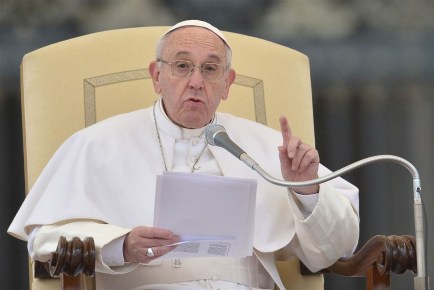
POPE FRANCIS CHANGING THE LORD’S PRAYER
The headline caught my attention; then, I caught my breath. As one of the two-point-two million Christians worldwide who know and love The Lord’s Prayer, I wondered what the Pope might be thinking. So, I went to the Internet to see what I could learn.
It was reported June 5, 2019 on Foxnews.com: “The Catholic leader changed the phrase ‘lead us not into temptation’ to ‘do not let us fall into temptation,’ as mentioned in the gospel of Matthew 6:13, because the original translation implies that God induces temptation. The change, officials said is closer to the original intent of the prayer.”
Quoting Pope Francis, the article continued, “”I am the one who falls; it’s not Him pushing me into temptation to then see how I have fallen,” Francis explained to Italian broadcasters about the phrase change. “A father doesn’t do that, a father helps you to get up immediately. It’s Satan who leads us into temptation, that’s his department.”
As a layperson, my first reaction to the Pope’s decision was, “If the Pope was concerned people would think God tempts us to do evil, he could have simply cited the verses from James 1:13-14 in the Authorized (King James) Version of the Bible: Let no man say when he is tempted, I am tempted of God: for God cannot be tempted with evil, neither tempteth he any man: but every man is tempted, when he is drawn away of his own lust, and enticed.
One positive outcome from the Pope’s decision may be that I and other concerned Christians will take a closer look at Matthew 6:13. Since we don’t have Jesus’ discourse in Aramaic, our next best option is to look at the Greek translation. One Greek/English translation Mounce Reverse Interlinear New Testament offers the following wording of Matthew 6:13 first in Greek, then in English”
Kai mē eispherō hēmeis eis peirasmos, alla rhyomai hēmkai mē eispherō hēmeis eis peirasmos, alla rhyomai hēmeis apo ho ponēros.’
‘and do not bring us into temptation but deliver us from the evil one.’
Matthew 6:13 (Mounce)
Most of what Jesus was saying in this verse seems noncontroversial, however, one word that may cause difficulty is peirasmos, which is translated “temptation.” In an article on http://www.neverthirsty.org, I learned: “The Greek word Peirasmos actually refers to a “trial,” an “affliction” and to a “proving.” The word does not refer to an attempt to intentionally make someone sin!” [emphasis added]
Based on this explanation of the word translated “temptation,” It would seem Matthew 6:13 does not, as Vatican officials suggested, imply that God induces temptation. Whether we say, “Lead us not into temptation.” or “Do not, let us fall into temptation,” the important point is we are exposed to temptation, so we need God’s help.
If you still are confused about whether God tempts us to do evil, please read what the apostle James wrote: And remember, when you are being tempted, do not say, “God is tempting me.” God is never tempted to do wrong, and he never tempts anyone else.
James 1:13 (NLT)
So, what is the best translation of the “Lead us not into temptation” section of
Matthew 6:13? Those who favor the 1519 Geneva Bible, the King James Bible, or The New International Version will continue to say, “And lead us not into temptation, but deliver us from evil”
The New American Standard translation renders those words in Matthew 6:13 — “And do not cause us to be tested; but save us from the Evil One.”
New Living Translation offers — “And don’t let us yield to temptation, but rescue us from the evil one.”
From the Amplified Bible (Classic Edition) we get: “And lead (bring) us not into temptation, but deliver us from the evil one.”
The International Children’s Bible provides, “And do not cause us to be tested; but save us from the Evil One.”
The Message Bible ignores the Greek altogether with “Keep us safe from ourselves and the Devil.”
One of the newer works, The Passion Translation puts it this way, “Rescue us every time we face tribulation and set us free from evil.”
Which translation is closest to Jesus words? Was the Pope right or wrong to make changes to the Lord’s Prayer? I guess we’ll just have to ask Jesus when we get to heaven.
But for now, I believe it is safe to suggest — in Matthew 6:14, Jesus was making the point that none of us is free from temptation and no one can overcome the devil without God’s help.
Blessings,
Your Friends in Christ
 Because He Loves Us Press