Dear Friends,
This past week we wept over the tragedy that took place at the Emanuel A.M.E. Church in Charleston, S.C. That was a shocking example of prejudice morphing into unquestionable evil. In the wake of Charleston, let’s examine our hearts to see if any seeds of prejudice threaten our walk with Christ.
Surprisingly, the word prejudice is not in the Bible; however, the Bible is full of examples of what we would call prejudice. The open hostility between the Jews and the Samaritans and between the Jews and the gentiles became the backdrop for several of Jesus’ parables.
It’s natural to notice differences between people. It’s how we react to the differences that can lead to sin. Jesus was raised in a culture where the Samaritans were considered to be second-class citizens, but he rejected the norm and related to the Samaritans in love.
Whenever we generalize and allow the sins of a few to color our opinions of an entire group of people, we are setting ourselves up for Judgment. An abundance of verses in the Bible warn us to avoid prejudice.
In Romans 14:10 we read, “You, then, why do you judge your brother? Or why do you look down on your brother? For we will all stand before God’s judgment seat.”
And in James, Chapter 2 “My brothers, as believers in our glorious Lord Jesus Christ, don’t show favoritism.”
Then there is Galatians 3:28 “There is neither Jew nor Greek, slave nor free, male nor female, for you are all one in Christ Jesus.”
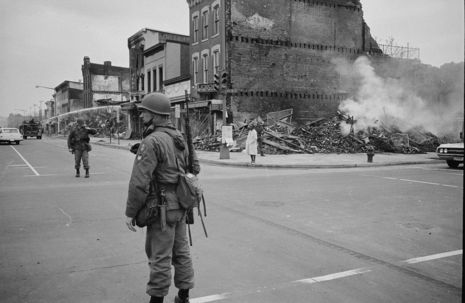
Allow me share a personal story about how seeds of prejudice were sown in my life, and what it took to repair the damage. Let me begin by mentioning that I grew up in the predominantly Afro-American Anacostia section of Washington, D.C.. On April 4, 1968, I left my home and drove towards Arlington, Virginia where I was planning to have supper. My drive took me down Pennsylvania Avenue and across the Sousa Bridge. After taking a slight left on Potomac Avenue, I slowed as a man, obviously under the influence, stumbled into the roadway and fell. I pulled over, got out of my car, and helped him to the curb. Seemingly out of nowhere, a crowd of fifteen or twenty angry people surrounded me. Someone shouted, “He tried to run that man over!” Another screamed, “I saw it, let’s teach him a lesson.”
From the midst of the crowd a middle aged African-American cab driver emerged. “That’s not so! I saw him actually helping our brother.” Then, the cab driver turned toward me and in a soft voice asked, “Boy, don’t you know what’s happened?”
I started to explain, “I was helping…” He interrupted me. “No man – get the Hell outta here – NOW! Somebody just shot Dr. King.”

Somehow I managed to get back into my car and drive away. Less than an hour later buildings in that area were in flames.
I canceled my supper plans and instead went to a hill in Arlington that overlooked Washington. The skyline was aglow from fires that had been ignited around the city. I can’t use the exact words I used. Suffice it to say they were vulgar and hateful. “This is my city, I screamed! I will never forgive THEM!”
That cab driver didn’t stereotype me. He didn’t care about the color of my skin; he saw me as another human being in trouble. His actions probably saved my life that evening. Sadly,I did not show the same kind of compassion for those who, in their anger, had burned “my” city.When it comes to prejudice, “If we claim to be without sin, we deceive ourselves and the truth is not in us.” 1 John 1:8
Looking at life through a prism of prejudice can lock us in a prison of negativity. Pulling down a flag or changing a law won’t automatically change people’s hearts; in fact, it may harden them. The question facing each of us is, “What can I do to clean out any seeds of prejudice I find in my heart?”
As a start, we each can pray that God will change our focus from what separates us to what we have in common. God made us all, and any advantage we have is a gift from God.
“For who makes you different from anyone else? What do you have that you did not receive? And if you did receive it, why do you boast as though you did not?” 1 Corinthians 4:7
Next, we can try to live the Great Commandment. When Jesus told us, “…thou shalt love thy neighbor as thyself,” he didn’t qualify it. He said, “Love thy neighbor,” and we are all neighbors in God’s eyes. It’s easy to love someone who is like you, but our commitment to Christ can be measured by how we treat everyone else.
How we speak about others also makes a difference. The Apostle James warned us, “With the tongue we praise our Lord and Father, and with it we curse human beings, who have been made in God’s likeness. James 3:9.
The Apostle Paul encouraged us to build up each other, rather than tear each other down: “Let us therefore make every effort to do what leads to peace and to mutual edification.” Romans 14:19
“Take control of what I say, O Lord, and guard my lips.” Psalm 141:3
Next, look for a hero. For a long time, the people who set the fires in D.C. were the first ones who came to mind when I thought about blacks. When I finally replaced the arsonists in my mind’s eye with Jim Williams, a compassionate, Christian gentleman – who just happened to be African-American – I saw what the love of Christ is really about. The bitterness and fear that fueled my prejudice evaporated in the intensity of Jim’s Christian love.
Jim was also the one who taught me the healing power of a smile and (where appropriate) a hug. When you lower your barriers and hug someone, you show them that you accept them as they are. We cannot cleanse our hearts and begin the process of reconciliation alone. We need to pray that the Holy Spirit will give us all a spirit of forgiveness. In Colossians 3:13 we read, “Make allowances for each other’s faults and forgive the person who offends you. Remember that Christ first forgave you, so you must forgive others.”
Removing the seeds of prejudice is difficult because they are often surrounded by pain or fear birthed by experience. In our minds, an offense by a few can lead us to diminish the value of many. The Christians at Emmanuel A.M.E Church have shown us that we have a choice when we are offended. They reminded us that red and yellow, black and white, all are precious in his sight; Jesus loves the little children of the world – and so can we.
Quotation for the week: Viktor Frankl, a survivor of Nazi death camps, noted in his book, “Man’s Search for Meaning,” that there are at core only two types of people — decent and indecent.”
Blessings,
Your friends in Christ


 Because He Loves Us Press