For the Lord himself will come down from heaven with a commanding shout, with the voice of the archangel, and with the trumpet call of God. First, the believers who have died will rise from their graves. Then, together with them, we who are still alive and remain on the earth will be caught up in the clouds to meet the Lord in the air. Then we will be with the Lord forever.
1 Thessalonians 4:16-17 (NLT)
My son John lives in Avon Park, a small community in central Florida. When he heard that I planned to spend Easter weekend with him, he went online to see just how far we would have to travel to find a special Easter service. Don’t get me wrong, every service that exalts our Lord and Savior is special. John and I are just spoiled from years of attending mega-churches.
John decided that we should attend the 9 AM service at Grace Bible Church in Sebring, Florida. He arrived at my motel which was just about a mile from the church at 9:40. We were in the church parking lot by 9:45.
The problem was there were no other cars. There were no other people, and there was no sign on the door to explain what happened.
“John, I said, “The rapture happened, and we missed it!”
I paused to consider the frightening consequences of being left behind. John interrupted my cogitation with an explanation: the Easter service had been moved to a coliseum on the other side of town. It was only a ten-minute drive, so we were in our seats before the service began. The music was familiar, there were baptisms, and the pastor gave a memorable message in which he started with Genesis and touched on all the books of the Bible, giving a short explanation of how all 66 of them point to Jesus.
As we left the service I thought about my comment, “The rapture happened, and we missed it.” Of course, we didn’t. But what if it happens tomorrow, or the next day? Am I ready? Are you ready? Is anyone ready?
The Bible tells us there is a way to be sure we are ready:
If you openly declare that Jesus is Lord and believe in your heart that God raised him from the dead, you will be saved. Romans 10:9
The message from Romans is, “Don’t be bashful about your faith. Better to be embarrassed, criticized, mocked, or condemned than to one day find yourself standing in an empty parking lot wondering where all the Christians went.
Advent: Leap for Joy
Christmas in a Nutshell
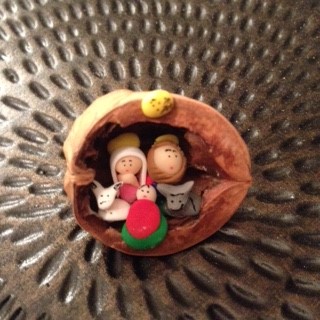
Dear Friends,
If someone asked you to give them the true meaning of Christmas in a nutshell, what would you say? Usually, people think about Mary and Joseph, the baby in a manger, the shepherds, and the wise men, the story of the nativity, as found in the gospels of Mathew and Luke. To get to a deeper understanding of the meaning of Christmas, turn to John 1:5.
In the beginning was the Word, and the Word was with God, and the Word was God. He was with God in the beginning. Through him all things were made; without him nothing was made that has been made. In him was life, and that life was the light of all mankind. The light shines in the darkness, and the darkness has not overcome it. John 1:1-5 (NIV)
In John 1, we learn much more about that baby born in Bethlehem. Jesus is the Word: the second member of the trinity who existed with God before anything came into being. He was the architect of creation who, with God, hung the stars in the sky and created a world where life was miraculously possible.
Existing outside of time and space, God is separate from His creation, yet when we read “In Him was life,” we are reminded that God is a person, not some impersonal force or prime mover. When Jesus prayed, “Abba, Father,” in the Garden of Gethsemane, he used a word that can be translated, “daddy.” In a world filled with so much darkness, it is comforting to know that “Our daddy,” who art in Heaven, loved us so much that he sent his Son as a light to shine into the darkness of the world.
Life may seem dark for you right now. The good news is that help is on the way. Christmas reminds us that we have a life-giving, all-powerful, and personal God who sent the Word as a light in our darkness.When Jesus spoke again to the people, he said, “I am the light of the world. Whoever follows me will never walk in darkness, but will have the light of life.” John 8:12 (NIV)
Blessings,
Your Friends in Christ
Advent: Leap for Joy

Last Sunday many churches began the celebration of Advent by lighting the first of five candles in the Advent wreath. In researching Advent, I discovered that the wreath is traditionally made of evergreens, symbolizing eternal life. The circle reminds us of the eternity of God and of his unending love, and the red berries in the wreath remind us it was Jesus’ sacrifice on the cross that provided the way to eternal life.
The four colored candles in the wreath serve to remind us of four virtues: Hope, Love, Joy, and Peace that emanate from a right relationship with God. The fifth candle, a white one, is symbolic of the sinless nature of Christ and is lit on Christmas Eve to remind us of Jesus’ words, “I am the light of the world. Whoever follows me will never walk in darkness but will have the light of life.”
John 8:12 (NIV)
During Advent it is traditional to read sections of the book of Isaiah in which the coming of Christ was foretold. The opening two chapters of Matthew and Luke describe the circumstances surrounding the birth of Jesus.
When I read Luke’s gospel, I am intrigued by the special relationship between Mary and Elizabeth. Both women were to give birth to miraculous sons. Elizabeth would be the mother of John the Baptist, and Mary would deliver Jesus to the world.
Elizabeth was the wife of a priest named Zechariah. Zechariah and Elizabeth were righteous in God’s eyes, careful to obey all of the Lord’s commandments and regulations. They had no children because Elizabeth was unable to conceive, and they were both very old. Luke 1:6-7 (NLT)
For a woman in the culture of that day to be childless was considered a curse. Imagine the hope Elizabeth felt when her husband came home speechless after being told by the angel Gabriel that Elizabeth was to have a son … a son who would be a man with the spirit and power of Elijah. He will prepare the people for the coming of the Lord. He will turn the hearts of the fathers to their children, and he will cause those who are rebellious to accept the wisdom of the godly.” Luke 1:17
Mary was a teenager, engaged, but not yet married to Joseph. She was a virgin, so she must have been stunned when the angel told her, “Don’t be afraid, Mary, for you have found favor with God! You will conceive and give birth to a son, and you will name him Jesus. He will be very great and will be called the Son of the Most High. The Lord God will give him the throne of his ancestor David. And he will reign over Israel forever; his Kingdom will never end!” Luke 1:30-33
Luke tells us that a few days after Mary received the news from the angel Gabriel, she went to visit her relative Elizabeth (who was now six months pregnant). Mary entered the room and greeted Elizabeth.
At the sound of Mary’s greeting, Elizabeth’s child leaped within her, and Elizabeth was filled with the Holy Spirit. Luke 1:41
Did you catch that? Elizabeth’s child leaped within her. Talk about joy! Had they sonograms back then, would the baby in Elizabeth’s womb have been smiling? Did the women giggle, as many expectant mothers sometimes do when their baby moves inside them? Did the women talk with one another about their separate encounters with the angel Gabriel? What did it feel like for Elizabeth when she was filled with the Holy Spirit?
I want to know things the Gospel writer was not inspired to share. I want to see Elizabeth and Mary and their unborn sons as real people with real life problems, whose faith in God fit perfectly within His plan of salvation. What can their lives teach us that will help us claim more hope, love, and peace this Christmas season? What can make us leap for joy in the presence of the Lord?
Elizabeth gave a glad cry and exclaimed to Mary, “God has blessed you above all women, and your child is blessed. Why am I so honored, that the mother of my Lord should visit me? When I heard your greeting, the baby in my womb jumped for joy. You are blessed because you believed that the Lord would do what he said.” Luke 1: 42-45
Like Elizabeth and Mary, we need to be open to God’s calling and blessed because we believe God will do what he says he will do.
HOPE: I pray that God, the source of hope, will fill you completely with joy and peace because you trust in him. Then you will overflow with confident hope through the power of the Holy Spirit. Romans 15:13
Blessings,
Your Friend in Christ
Golf, a Phone, and the Holy Spirit
I spent a good portion of the morning working on the melody for a new song. Deciding that I needed a break, I threw my golf clubs in the car and headed to the Highlands golf course in beautiful Bella Vista, Arkansas. This is a course that, I had been cautioned, was not for amateurs, but ignoring my 32.5 handicap—if you are a non-golfer, that’s abysmal—I ventured forth.
I was paired with Caleb and Dorian, two men in their thirties who announced they would be playing from the yellow tees. I play from the reds, sometimes referred to as the ladies’ tees, but that is sexist and demeaning, so they are henceforth and forever more the senior’s tees. Both of my playing partners announced that it had been quite a while since they played, so I shouldn’t have expected much from them.
Both hit drives that I only wish I had the power to hit. They both wished the course designer hadn’t put trees where their shots landed. By the end of nine holes, they had lost at least ten golf balls between them. I lost two.
As usual, my first drive landed smack in the middle of the fairway about 130 yards out. It took two more shots to reach the green, where I two-putt for a 5. That was one of three fives I had on the first nine. I didn’t have enough fingers to count my score on most of the other holes. Let’s just say, “I shot fifty-fiveish to the turn…make that sixtyish”
At the turn, Caleb and Dorian decided they were going to stop for a sandwich. Continuing a ministry my Bonnie started, I make it a habit to offer an olive wood cross from Israel to men I play golf with for the first time. But I just wasn’t in the mood. Then that soft voice in the back of my head told me, “Give them a cross.”
That’s when the bargaining began. “I don’t think they’d want one,” the other voice inside my head offered. “Besides they have already headed to the restaurant. I’m not going to chase them.”
“Caleb was Joshua’s sidekick when Moses sent the search party into the promised land, the soft voice offered.”
“Yes, but the other one is named Dorian, I responded. The Portrait of Dorian Gray makes me feel old.”
“You are old,” the other voice reminded me.
As I made the turn to the next tee, I went the wrong way and happened upon Caleb who was parking his golf cart. “I have something I like to share with my playing partners when I play a round without swearing, especially when I play as poorly as I played today.”
“Oh! There was plenty of swearing,” Caleb said.
“No, I mean when I don’t swear.“ I handed him a cross and a cross for Dorian, “This is a reminder that God loves you, even when the golf course doesn’t.”
He seemed pleased to receive the gift. I proceeded to the next tee, hit a shot off into the woods, followed by a near-perfect mulligan drive to the center of the fairway about 150 yards out. Not sure of the distance to the green, I reached for my phone which has a distance finder app. “
Oh, God,” I muttered. “I must have dropped my phone somewhere on the course.
I returned to the cart shack and asked if anyone had turned in my phone. The foursome that followed us had already checked in and had not reported finding a phone. “I’m going to see if I can find it,” I announced, as I sped away.
My search took me to all the locations I could remember stopping to take a wack at another shot. I had narrowed my search to the last three holes played, but moved on to the next hole, just in case.
That voice in my head that always brings up the negative side of any situation reminded me how much trouble it would be to replace my phone. My phone had become my surrogate brain. Everything I need to know is in my phone: names, phone numbers, email addresses, birthdays, doctor appointments. I am brain-dead without my phone.
Suddenly, an unusual peace came over me. “This is just an inconvenience; it will all work out.” Moments later, I saw the starter driving up in a golf cart, waving to get my attention. “Someone brought in your phone ten minutes after you left to search,” he shouted. They have it back at the pro shop.”
As I started back toward the pro shop, a wave of thankfulness washed through me. Tears started to flow. After offering a prayer of thanks, laughing, I spoke to that soft voice inside my head, as I explained to myself what happened, “You were testing my obedience, weren’t you?”
That soft voice, possibly the Holy Spirit, had nothing more to say.
Below are the lyrics to the song I was working on this morning: I may have to substitute the word “golf” for “Church” in the final version. You can choose whatever words apply to your situation.
If Only I Could Serve the Lord
“If only I could serve the Lord,” I heard a Christian say,
“I’d build a church or feed the poor, but life gets in the way.
My home, my work, yes even church can keep me occupied,
and I forget to serve the one who on that cruel cross died.
Forgive me, Lord, for putting you in distant second place,
. when you gave all to rescue me through your amazing grace.
Lord, help me show my thankfulness for all the gifts you give,
and show the world that you’re my Lord by how I choose to live.
The God of Hope brings joy and peace to those who trust in Him.
He saved us from our fallen state and washed away our sins
To live and love and serve like Christ, a vision we now claim.
Let everything, we do today bring honor to God’s name.
May the God of hope fill you with all joy and peace as you trust in him, so that you may overflow with hope by the power of the Holy Spirit. Romans 15:13
Is America a Racist Nation?
Let me offer a glimpse of history from a different perspective. Growing up in Washington, D.C. during the 50s and 60s, I saw prejudice from both sides of the fence, and I want to say at the outset that stereotypes that govern our fears are wrong and have been and continue to be wrongly exploited to keep us separate.
In 1954, the Supreme Court, in Brown versus the Board of Education, ruled that separate, but equal schools were not equal, and therefore unconstitutional. Over the summer, I was transferred from Eastern Elementary School to Kingman Elementary. It was the first time I had any extended contact with another race, and I can tell you it was as uncomfortable for my new classmates as it was for me. People who grew up in other parts of the country where schools were traditionally integrated cannot understand how difficult it was to make that transition.
Immediately following Brown versus the Board of Education, white families fled Washington to the suburbs. Mr. Mosser was the first on our block to sell to a negro family. (Please don’t be offended by the words I use in this piece. This was the language of the day.) Mr. & Mrs. Hines, with their daughters Judy and Risa, were wonderful neighbors, as were other negro families that moved in, but that didn’t matter. Within six months, D Street Northeast had only a handful of white families.
My life was not significantly impacted by integration. There were a few small incidents at school — nothing beyond what you might find at other schools. I played with the kids in the neighborhood, swam in the Rosedale pool, and pretty much got along with everyone.
My interest in school started to wane in the fifth grade. In the sixth grade, Portia Ware, a wonderful colored teacher (another term we used) rekindled my interest in learning. I joined the staff of the school newspaper and was given the job of selling ad space. One potential advertiser, a black man who owned a shop on H Street, pulled a knife on me and told me to get the hell out of his shop. By contrast, there was the Jewish owner of Sam’s Car Wash who not only bought an ad, he also gave me a job passing out fliers.
During the summer between sixth and seventh grades, a couple of incidents changed everything for me. My white friend Howard Riley and I were playing tennis on the court behind Eliot Junior High. It had turned dark, and we were about to head home when I felt something hit me in my side. As I turned to see what happened, a sharp jab to my nose knocked me to the ground. I looked up and saw two black kids — probably high school age — laughing at me. They ran away as Howie came running toward me with his tennis racket ready for battle.
A few weeks after my attack, my brother Tommy and his friend Terry Posey were sitting on a fence when they were sucker-punched by a group of colored men. I became afraid and spent more nights than I like to remember crying myself to sleep. When I returned to school in the fall, several of my classmates learned about my attack and started to taunt me. “The LeDroit Park gang is coming to school,” they whispered, “and they are looking for you.”
One day I was looking out the 3rd floor window of my classroom and saw a car pull up. A high-school age kid got out and started toward the school. I don’t remember the boy’s name, let’s call him Ronald. My classmates had told me he was the one who was after me, and I knew he would be waiting for me when school ended.
After about five minutes, I noticed that the boy was peering through the window into our classroom. I don’t know where the teacher had gone; she was not in the room As he walked through the door, I stood up, raised my hand, and gave him the come here signal with my index finger. He came toward me and I directed him into the coatroom.
With a quivering voice, I asked, “Why do you want to hurt me?”
“Hurt you? Who the hell are you?”
I told him my name and he shrugged. “I’m here to see my little brother. I don’t have any issue with you.”
I had spent countless sleepless hours worrying about the day Ronald would come. How sad. Fear has been called “false expectations appearing real.”
Seventh grade found me at Eliot Junior High. I remember playing touch football in gym class. No matter how open I got, the ball never seemed to come my way. Then, in a particularly tight game, the quarterback, racing to avoid being tagged, threw the ball in my direction. I can still see the ball coming toward me. I stretched out my hands and the hard rubber football landed securely in my palms. I ran across the goal line with the winning touchdown. From then on, the other team always had to cover me, even though the ball seldom came my way.
One afternoon I was killing time alone in one of the far corners of the playground. A kid who had a reputation for being a bully approached me. “You’re pretty smart, aren’t you?” he said.
“I do OK,” I responded, knowing that being smart was enough of a reason for him to kick my butt.
“I’m having trouble in math class. Could you explain this equation to me?”
I helped him. A few years later he repaid my kindness.
In April or May, I made the mistake of ticking off a kid named Richard S. The challenge was issued, and Richard said he would see me after school. At the end of the school day, each homeroom would form a line, march down the stairs, and exit the front of the school. There was no escape! There was no escape unless you were at the back of the line and knew you could slip out a window in one of the ground-level classrooms and exit from the rear of the school. Which I did.
That worked for about a week. Then one of the kids told our homeroom teacher what I had been doing, and she instructed me to exit the school with the other kids. I made it as far as C Street before Richard and his friends caught up with me. They had started to push me around when my friend Riley came along in his cadet uniform. He wore his ceremonial sword, so everyone paid attention when he told them to leave me alone. Richard gave me a quick kick in the butt, then everyone headed home. Howie and I stayed friends until he stole my girlfriend from me just before my high school senior prom.
The 8th and 9th grades were for the most part uneventful. I became president of the Bible Club, and Norman Tennebaum, a Jewish kid, became vice president. (Yes, there used to be Bible clubs in public schools.) Most kids at Eliot liked Norman and me, and much to my surprise, we were contenders for the coveted American Legion Award. The day before the award ceremony, I was going up the stairs when Pokey, a short, pesky kid tripped me. As I fell, I spun around and kicked him in the chest which sent him tumbling back down the steps. He wasn’t hurt, nevertheless, the inevitable challenge was offered. Pokey was smaller than me, so I knew a pushing match was the most I had to fear.
But when I exited the school, I saw Pokey and Norman Tennebaum going at it in the middle of a circle of kids. I thought for a moment about getting involved but headed home instead. At the awards ceremony the next day, I received the American Legion Award for good citizenship. I have always been chagrined that my name was inscribed over the poorly erased name of Norman Tennenbaum. There is an interesting back-story in our book.
Over the summer, my dad took Mom and me to Florida to care for his aging aunt. Aunt Etta had a lovely little home in Palm Beach. I enrolled in the High School that was across the bridge in West Palm Beach. At school, I discovered discrimination is not always a race thing. Wanting to help me “fit in,” my dad bought me several Hawaiian shirts. Not only did the kids at the high school not wear Hawaiian shirts; They also didn’t wear anything that had colors that would run when you got caught in the afternoon thunderstorms. The fact that I dressed funny and was incorrectly identified as one of the ‘rich kids’ from across the bridge made me persona non grata. It’s no surprise; I do not remember the names of any of those students or the teachers at that school.
I returned to Washington in January and prepared to enroll in Eastern High School. On the first day of school, I was walking up the steps when I encountered the principal “Are you Donnie Sennott?” he asked.
“Yes sir.”
Do you have a brother Tommy and sisters, Pat and Shirley?
Again, I answered, “Yes sir.”
I couldn’t believe his next words. “You are expelled. I will let the principal at Anacostia know you will be attending there.”
Anacostia was a high school that had about a 50-50 mix, as opposed to Eastern which was, I believe at the time, all black. My high school years probably would have been significantly more difficult had the change not happened.
The Supreme Court decision in Brown versus the Board of Education was validated when I started classes at Anacostia. I had attended Palm Beach High School for only a semester, but it took the rest of the school year for me to encounter anything in my classes at Anacostia that hadn’t already been covered in my classes in Florida. If you will allow a personal opinion: forcing children to attend substandard schools is one of the cruelest forms of racism.
Race relations were excellent at Anacostia. I started dating a wonderful Christian girl who was as “color blind” as anyone I have ever known. Our ‘click’ included whites, blacks, Christians, and Jews. During my years at Anacostia, I only felt uncomfortable following a football game against Spingarn High School. I, with my girlfriend Mary and our friends Steve G. and Deana P., was walking home from the game when we spotted a group of ten to twelve Spingarn students walking toward us.
Looking toward the girls I said, “This doesn’t look good. You two should run toward that house if they start running toward us. Steve and I will try to delay them until you reach safety.”
I was scared. The group stopped across the street from us and seemed to be deciding which way to go. The apparent leader looked familiar. He stared at me, smiled, then pointed at another Anacostia student, Richard, and led the gang as they ran past Richard H., punching at him as they ran by. The gang leader was the bully from Eliot Junior High that I had helped with the math problem.
My father served with the Metropolitan Police Department. When I was nine or ten, he’d take me to Harvey’s Garage in Southwest D.C., where a group of policemen would gather with other cops to discuss the week’s events. Was there prejudice? Of course, there was. My dad worked in the predominantly black 14th precinct, and he had to deal with the criminal element. Did he use language that today is recognized as unacceptable? Yes. Was he a racist? That’s debatable.
Ed Sennott was loved by family and friends. At his funeral, many stood to praise him. Nearing the end of the service, the minister asked if anyone else would like to speak. From the back of the church, we heard a woman with a soft voice ask if she could speak. My brother and I turned to see a neatly dressed black woman coming forward. “This isn’t going to be pretty,” Tommy whispered.
“Thank you for letting me speak,” the woman said. You don’t know me, but Mr. Sennott was very special to me.” She paused as she tried to control her emotions. “You see, when Mr. Sennott took over the statistics department at the Metropolitan Police Department, he had the opportunity to hire someone to assist him. He hired me. I was the first black woman hired for a significant administrative position within the MPDC.”
You are so intimately aware of me, Lord. You read my heart like an open book and you know all the words I’m about to speak before I even start a sentence!
Psalm 139:3 (TPT)
In the book YOUR HEART IS AN OPEN BOOK: Fill It With God’s Love, Bonnie and I included a story titled “Seeds of Prejudice,” in which I shared how the seeds of prejudice were sown in my heart following the murder of Martin Luther King, Jr. Standing on Ridge Road in Arlington, Virginia, watching the glow of fires in the distance as rioting spread across Washington, I felt an anger that could have consumed me. It took years for that anger to be healed.
“In your anger do not sin”[a]: Do not let the sun go down while you are still angry, and do not give the devil a foothold. Ephesians 4:26-27 (NIV)
There is a wave of anger spreading across our nation that threatens to consume us. The loudest voices aren’t always the wisest, but they are the ones the press tends to highlight. Calls for reconciliation are being drowned out by demands for retaliation and retribution. Too many are becoming what they claim to hate.
Is America a racist nation? No. America is a nation that has people of all races, religions, genders, and political persuasions who allow prejudices to influence how they treat others. It’s time we took the following words from Colossians to heart
Be merciful as you endeavor to understand others, and be compassionate, showing kindness toward all. Be gentle and humble, unoffendable in your patience with others. Tolerate the weaknesses of those in the family of faith, forgiving one another in the same way you have been graciously forgiven by Jesus Christ. If you find fault with someone, release this same gift of forgiveness to them. For love is supreme and must flow through each of these virtues. Love becomes the markof true maturity.
Colossians 3:12b-14 (TLB)
Blessings,
Don
To Kneel or Not to Kneel
Growing up in the Church of the Epiphany in Washington, D.C., serving as an acolyte may be part of the reason for my bad knees. Even when the Book of Common Prayer indicated congregants could either stand or kneel, Rector Kane opted for kneeling. In fairness, I must admit that soccer, tennis, and football deserve most of the blame for my bad knees.
As a young adult, I found kneeling uncomfortable and spent part of the time on my knees, allegedly in prayer, praying that the prayers would soon end. Why would he put us through such torture? I wondered. As I look back on those days, I realize that I was trending toward the less spiritual side on the pendulum of spirituality,
Recently, I was reintroduced to Psalm 95, and the words—Come let us worship and fall down. Let us kneel before the Lord our maker—caught my attention. I wondered how many times the words kneel or bow down (related to the worship of God) appear in the Bible. I discovered a score or more verses about bowing down to God and scores of verses that refer to God’s prohibition on bowing down to worship anyone or anything else.
Bow down – a verb meaning to bend at the neck, waist, or knees as a display of respect, honor, or obedience. It is an expression of humility.
It is noteworthy that the only verses in the New Testament that use the words bow down are found in Matthew 2:11 where the Maji bowed down to the baby Jesus, and the words Satan spoke to Jesus,
recorded in Matthew 4:9: “All this I will give you,” he said, “if you will bow down and worship me.”
In Ephesians 3:14, the apostle Paul wrote about kneeling to the Father, but that was more of a comment on his personal practice, not a general prescription for prayer. Does that mean that bowing down (kneeling) became old school, something that was not required of followers of Jesus?
I believe that New Testament writers used another word found approximately 70 times in the Bible: humble. Over the years, countless pastors have reminded their congregations, “If something appears three times in Scripture, God wants you to pay special attention to it.” What about verbs (action words) that appear repeatedly, like bow down and humble?
Come, let us bow down in worship, let us kneel before the Lord our Maker;
for he is our God and we are the people of his pasture, the flock under his
care. Psalm 95:6-7 (NIV)
The Lord upholds all who fall and lifts up all who are bowed down. Psalm 145:14
Humble yourselves, therefore, under God’s mighty hand, that he may lift you up in due time.
1 Peter 5:6
So, what do we do about this? It is unlikely (and not something I would encourage) that our churches will suddenly start to include kneeling during prayer as part of their ritual. It would be uncomfortable for many and seem legalistic to others. There is, however, something every believer can choose to do on their own. In your quiet time, bow down in worship, kneel before the Lord our maker.
Recently I found myself in a dry period when it came to my prayers. I was saying the words, but my mind and heart were elsewhere. Then one morning, I don’t know if it was part of a devotional, remembrance of a sermon, or something I heard on the radio, but Psalm 95 came to me as a powerful
instruction. I got out of bed and went to my knees in prayer.
Instead of just praying because praying is expected, I felt I was in a genuine conversation with our Lord. Let me correct that; I was in a meaningful soliloquy with the Lord. I am listening more attentively, but the lines of communication have been inactive for a while. Psalm 95:8(a) continues, Today, if only you would hear his voice…
Lord, help us to hear Your voice and worship You in a posture that is
pleasing to You. AMEN
 Because He Loves Us Press