Dear Friends,
“Life is made up of moments. Perhaps this is the moment for which you have been created.” – Author unknown.
This weekend, our Jewish brothers and sisters celebrate the joyous holiday of Purim. You can read the story of Purim in the Book of Ester, but here is our “Cliff Notes” version.
King Ahaserus (Xerxes) ruled the Persian Empire, whose boundaries ranged from India to Ethiopia, from 486 BC until his assassination in 465 BC. When his wife Queen Vashti refused the king’s request that she “display her beauty before the people and the officials … the king became very angry.”
When the king asked his advisors what should be done to the queen for her disobedience, the advisors warned that if she wasn’t punished, the queen’s conduct will be known to all women, causing them to look on their husbands with disrespect.
For the sake of “domestic tranquility,” Queen Vashti was dethroned and a replacement was sought. The king decreed, “Every man should be the master and rule in his own home.” Esther 1:22 (NIV)
[Writer’s comment to married women: If your husband tries to use this verse on you, suggest he read 1 Corinthians 13.]
Back to the story … In a search for a new queen, beautiful virgins were brought to the king’s palace from all over the empire. One of those who was chosen was the niece of Mordecai, who was an attendant in the king’s court. Esther was beautiful of form and face. Like all of the other’s chosen, she went through an extensive 12-month beautification program.
Each of the candidates went before the king, but it was Esther who found favor and kindness with him more than all the other virgins, so that he set the royal crown on her head and made her queen in place of Vashti.
[Here the plot thickens. Following the instructions of her Uncle, Esther had not revealed her Jewish background.]
When Mordecai learned that two of the king’s guards were plotting to kill the king, Mordecai informed Esther, who told the king in Mordecai’s name. Both conspirators were hanged when the plot was investigated and found to be true.
A while later, the King promoted Haman [one of his top advisors] and established his authority over all the officials who were with him. All the kings servants … bowed down and honored and paid homage to Haman; for this is what the king had commanded in regard to him. But Mordecai [a Jew of the tribe of Benjamin neither bowed down or paid homage to him.”
The others who served at the gate tried to convince Mordecai to obey the king’s command to honor Haman, but when he refused to listen, they told Haman that Mordecai’s reason for not bowing down was that he was a Jew. [Writer’s note: Mordecai believed that bowing down to Haman would violate God’s commandment, “You shall have no other gods before me.” Exodus 20:3
Haman was furious. But punishing Mordecai was not enough; Haman was determined to destroy all the Jews, who throughout the kingdom. Looking for an auspicious day to approach the king with his plan, Haman cast Pur, that is the lot, … day after day, month after month, until the month of Adar (Feb-Mar).
“There is a certain people scattered throughout the kingdom,” Haman explained to the king, “whose laws are different from those of all other people; and they do not observe the king’s laws. If it pleases the king, let it be decreed that they be destroyed, and I will pay ten thousand talents of silver into the hands of those who carry out the business …”
The king sent out a decree to kill and to annihilate all of the Jews, in one day, (March 7, 473 B.C.) and to seize their belongings as plunder. Throughout the kingdom, Jews began fasting and mourning. When Esther heard of the decree, she sent Hathach, one of her attendants, to Mordecai, to learn what had happened. Mordecai told Hathach everything that had happened and gave him a copy of the decree which had been issued for the destruction of the Jews, so he might explain it to her and order her to go to the king to seek his favor and plead with him for the lives of her people.
Esther sent Hathach to Mordecai with a message that she had not been summoned by the king for 30 days and “Any man or woman who comes to the king to the inner court without being summoned, he has but one law, that he is to be put to death.”
Mordecai sent a message back to Esther, “Do not imagine that you in your palace can escape any more than all the Jews. For if you remain silent at this time, liberation and rescue will arise from and another place, and you and your father’s house will perish. And who knows if you attained royalty for such a time as this [and for this very purpose.]
Esther told Mordecai to declare a three-day fast, after which she would go to the king.
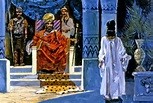
Fast forward … Esther approached the king and found favor in his sight. “What is your request, he asked, “It shall be given to you, up to half the kingdom.”
Esther’s request: Invite Haman to supper! When Haman received the invite, he went around boasting of his success to all of his friends, but he told them he would not be happy as long as he saw Mordecai the Jew sitting at the king’s gate. His wife and all of his friends told him to build a gallows and ask the king to have Mordecai hanged on it. So, Haman had the gallows made.
“That night the king could not sleep; so he ordered the book of the chronicles, the record of his reign, to be brought in and read to him. It was found recorded there that Mordecai had been the one who had exposed the plot to kill him. When he learned that nothing had been done to honor Mordecai, the king asked if there was anyone available whom he could consult. As perhaps God had planned it, Haman was waiting to see the king in order to request that the king hang Mordecai.
When the king asked Haman, “What is to be done for the man whom the king desires to honor? Thinking the king was speaking of him, Haman suggested that he be handed over to one of the king’s most noble officials, who should dress him in a royal robe and lead him on horseback through the city, proclaiming, “This is what shall be done for the man the king desires to honor.”
Imagine the look on Haman’s face when the king said, “Do this for Mordecai.”
After carrying out the king’s order, Haman returned home to tell his wife and his friends what had befallen him. While they were speaking to him, the king’s carriage arrived to bring him to the banquet Esther had preferred.
[Haman just ate crow, and now he’s heading to a banquet with a sour stomach.]
At the banquet, the king repeated the offer he had made to Esther to “grant her request, to give her up to half his kingdom.
Esther replied, “Let my life be spared as my petition, and my people be spared as my request,” When she explained that it was her people that Haman had singled out for extinction, the king became enraged and went to the courtyard to decide what to do. When he returned he found Haman, who had been pleading for mercy, on the couch with the queen. “Will he even attempt to assault the queen with me in the palace?” Ironically, Haman was hanged on the gallows he had prepared for Mordecai.
The king gave the House of Haman to Esther, and when he learned Mordecai’s relationship to her, the king put him in charge of the House of Haman with all its authority.
Again, Esther pleaded before the king, asking that the decree for the destruction of the Jews be rescinded. The king authorized Mordecai to send out an edict that granted the Jews in every city the right to assemble and protect themselves; to destroy, kill and annihilate the armed men of any nationality or province who might attack them and their women and children, and to plunder the property of their enemies.
On the day that had been assigned for the destruction of the Jews, it was their enemies who were destroyed — 500 in the capital city of Susa alone. But nothing was plundered.
The story of Esther’s heroism became the inspiration for the holiday of Purim.
“Mordecai recorded these events, and he sent letters to all the Jews throughout the provinces of King Xerxes, near and far, to have them celebrate annually the fourteenth and fifteenth days of the month of Adar as the time when the Jews got relief from their enemies, and as the month when their sorrow was turned into joy and their mourning into a day of celebration. He wrote them to observe the days as days of feasting and joy and giving presents of food to one another and gifts to the poor.” Esther 9:20-22
Perhaps this is the day YOU were created for. Praise God.
Verse for the Week: Genesis 12:3
“I will bless those who bless you, and whoever curses you I will curse; and all peoples on earth will be blessed through you.”
Blessings,
Your Friends in Christ

 Because He Loves Us Press