Dear Friends,
One way to bring the Bible to life is to put yourself in the shoes of the characters in key stories. This week we try to imagine what it was like to be one of the two disciples who met Jesus on the Road to Emmaus following His resurrection. This encounter is found in Luke 24:13-35.
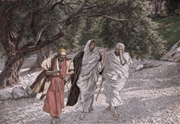
My name is Cleopas. I and another disciple were walking to Emmaus, a small village about seven miles from Jerusalem when we were approached by a stranger. At first, I thought he was from another region because he didn’t seem to know anything about the things that had happened in Jerusalem. I even asked him, “Are you the only one visiting Jerusalem who does not know the things that have happened there in these days?”
My companion and I started to tell him about Jesus of Nazareth. We told him that Jesus was a prophet, powerful in word and deed before God and all the people — we had hoped he was the one who was to redeem Israel (The Messiah). But, the chief priests and our rulers had turned Jesus over to the Romans, who had crucified him.
This was the third day and Jesus had said he would be raised from the dead. Mary Magdalene, Mary the mother of James, and Salome had gone to the tomb early in the morning and found the large stone at the entrance had been rolled away, but they didn’t find Jesus body. They told us that they had seen a vision of angels who told them Jesus was alive. The disciples Peter and John had run to the tomb and found it was as the women said, but they did not see Jesus.
When we finished speaking, the stranger spoke, “How foolish you are, and how slow to believe all that the prophets have spoken! Did not the Messiah have to suffer these things and then enter his glory?” And beginning with Moses and all the Prophets, he explained to them what was said in all the Scriptures concerning (Jesus).”
As we approached the village to which we were going, the stranger continued on as if he were going farther. But we urged him strongly, “Stay with us, for it is nearly evening; the day is almost over.” So he went in to stay with us. When he was at the table with us, he took bread, gave thanks, broke it and began to give it to us. Then my eyes were opened and I recognized Jesus. Then he disappeared from our sight. I asked my companion, “Were not our hearts burning within us while he talked with us on the road and opened the Scriptures to us?”
Why didn’t we recognize Jesus? I guess you could say we lacked “expectant hope”. We didn’t see Jesus because we didn’t truly expect to see him. Can you blame us? Our Master had promised he would be raised from the dead, but after his torture and murder at the hands of the Romans, who could expect to see him walking and talking as if nothing had happened? I didn’t recognize Jesus because I had put my hope in Jesus the man, not Jesus the Son of God.
I should have remembered Proverbs 11:7: “Hopes placed in mortals die with them; all the promise of their power comes to nothing.”
Who do we put our hope in? Isaiah tells us, “… Those who hope in the Lord will renew their strength. They will soar on wings like eagles; they will run and not grow weary, they will walk and not be faint. Isaiah 40:31.
The Psalmist tells us, “Guide me in your truth and teach me, for you are God my Savior, and my hope is in you all day long.” Psalm 25:5. Notice the phrase, “My hope is in you all day long.” Are we hoping expectantly for God to respond to our prayers? Do we even pray, or is our first response to turn inward or outward rather than upward?
Recently I went through a difficult period when an important project didn’t go as planned. Being a man, I immediately went into problem-solving mode, searching Google for answers, contacting friends for ideas, and doing everything in my power to make things right. Finally, accepting the old adage — when all else fails — pray; I turned to prayer.
The problem still exists. Some might argue that God ignored my prayers, but I would say he responded by helping me to change my attitude about the problem. As I walked my own Emmaus Road, I initially failed to see who was walking with me. Like the disciples on the Road to Emmaus, we need to learn to live with expectant hope.
Verse for the Week: Micah 7:7
“But as for me, I watch in hope for the Lord, I wait for God my Savior; my God will hear me.”
Blessings,
Your friends in Christ

 Because He Loves Us Press